


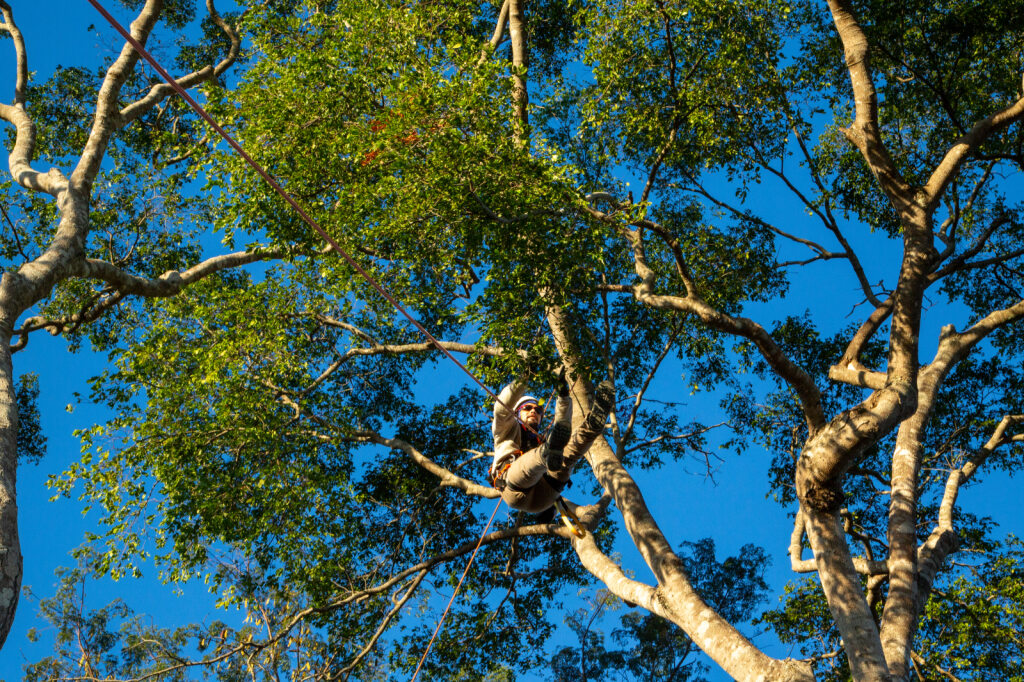
Every day, seeds cross dirt roads, processing sheds, nursery greenhouses and reach the ground where there was once a forest. In each of them lies the possibility of reversing the environmental degradation of the Rio Doce Valley – and this work begins with those who live in the countryside.
At Instituto Terra, collecting native seeds is essential for the success of ecosystem restoration. This is how hundreds of species from the Atlantic Forest are preserved, multiplied and reintroduced into degraded areas. But this is only possible thanks to the partnership with the region’s rural producers, who open up their properties to receive the Terra Doce program’s mobilizers and help find the right species at the right time.
Currently, seeds are collected from a radius of up to 200 km from the Institute’s RPPN, involving properties in 14 municipalities along the middle Rio Doce, between Minas Gerais and Espírito Santo. Each season brings a new cycle of seeds, and the team travels through different forest fragments every day to ensure the genetic diversity of the seedlings produced in the nursery.
After collection, the seeds are processed and catalogued in the laboratory. Care continues in the nursery, where each one is monitored until it becomes a healthy seedling ready to go into the field. These seedlings are used in reforestation actions, which today total more than 2,000 hectares in areas inside and outside Instituto Terra.
The restoration chain is sustainable because it involves those who live in the territory. Seed collection connects environmental conservation with income generation, community engagement and the strengthening of knowledge exchange networks. For rural producers, it’s a chance to contribute to the protection of biodiversity and, at the same time, be part of a concrete transformation of their surroundings.
Among the species collected are emblematic Atlantic Forest trees such as Sapucaia, Cajazinho, Ingá-branco, Paineira-rosa, Bapeba and many others. Each one has its own time, shape and function in rebalancing ecosystems.
Instituto Terra continues to invite new partners to join the network. The more properties involved, the stronger the forest we want to rebuild will be. If you are a rural producer and want to get involved, get in touch with the Terra Doce program’s mobilization team. Your land could be the start of a new forest.
This work is being carried out with the support of the Semente project, an initiative of the Public Prosecutor’s Office of Minas Gerais, through the Center for Operational Support of the Environment (CAOMA), in partnership with the Minas Gerais Center for Intersectoral Alliances (CeMAIS). The project aims to ensure transparency, effectiveness and the strengthening of relevant socio-environmental actions by connecting third sector institutions with prosecutors throughout the state. Through it, the seed collection promoted by Instituto Terra gains scale, legal backing and visibility as an instrument for environmental and social transformation.