
Skip to content
  • The institute
    • Who we are
    • Our history
    • Ecosystem Restoration
    • Environmental Education
    • Rural Development
    • Our Team
    • Our Work
    • Reports
    • Foundation
  • News
  • Visit
  • Contact
    • Contact us
    • Press room
  • The institute
    • Who we are
    • Our history
    • Ecosystem Restoration
    • Environmental Education
    • Rural Development
    • Our Team
    • Our Work
    • Reports
    • Foundation
  • News
  • Visit
  • Contact
    • Contact us
    • Press room
  • Support
    • Sponsors
    • Legal Entities
    • Individuals
  • Store
  • Support
    • Sponsors
    • Legal Entities
    • Individuals
  • Store
  • EN
    • PT
Doe
  • The Institute
    • Who we are
    • Our history
    • Ecosystem Restoration
    • Environmental Education
    • Rural Development
    • Our Team
    • Our Work
    • Reports
    • Foundation
  • News
  • Visit
  • Contact
    • Contact us
    • Press room
  • Support
    • Partners and Sponsors
    • Individuals
    • Corporate Support
  • Store
Doe
  • PT
  • EN

How a forest is born: behind the scenes of 27 years of restoration

There was no shade. There was no birdsong. There was no forest. When Instituto Terra began restoring the former Fazenda Bulcão, what you could see on the horizon was exhausted soil, covered in grass and silence. What do we see today? More than 3 million trees planted, more than 230 species of animals back, a new landscape – and many lessons along the way.

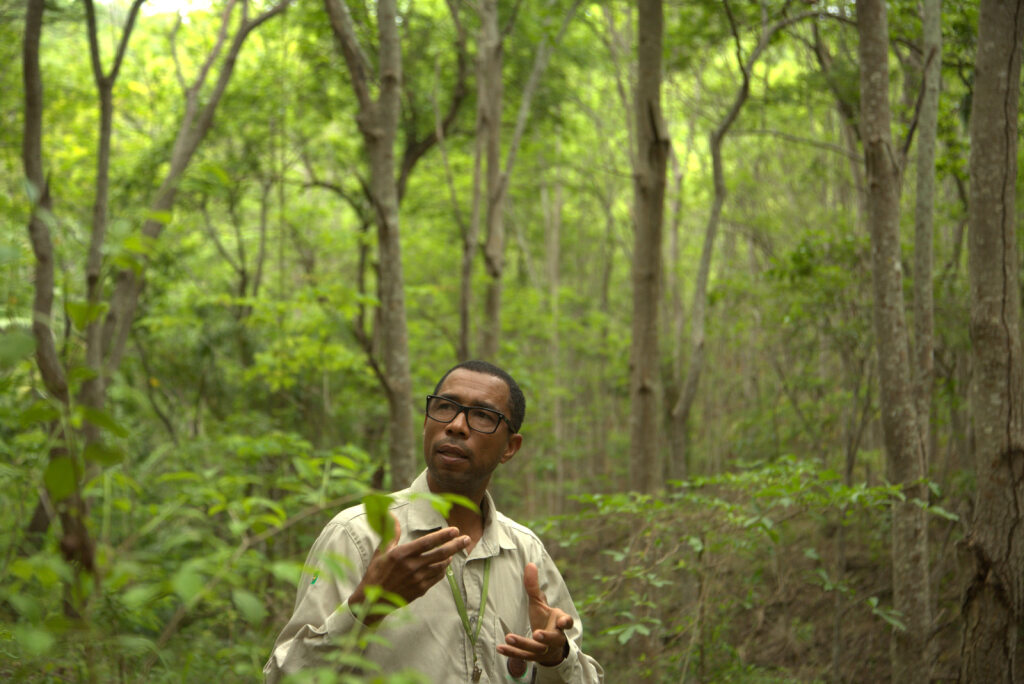
Restoring an entire ecosystem, especially in a territory marked by historical degradation and high climate sensitivity, such as the Rio Doce Valley, was a challenge that required time, technique and persistence. “It wasn’t easy over the 27 years, especially at the beginning, when there was no vegetation at all,” recalls one of the collaborators in a video. “We learned, adapted, trained… and with the challenges came experience.”

This experience doesn’t just take place in the act of planting. It starts much earlier, when seeds are collected from fragments of the Atlantic Forest scattered around a radius of up to 200km. It is in this plant prospecting that the Institute’s team finds the species that will make up the planting of the new areas – and the enrichment of the native vegetation of the Private Natural Heritage Reserve (RPPN).

Each seedling has its own story. Some seeds need to break thermal dormancy, others need to be sanded or soaked, all by hand. The diversity of species requires a technical and careful look at each one’s cycle: fruiting time, germination rate, growth time, ecological behavior. In 2024, 405,000 seedlings were grown in the Institute’s nursery, with seeds from 138 native species.

In fact, the nursery has become a learning center. Programs such as NERE (Center for Ecosystem Restoration Studies) and Terrinhas use the space as a living classroom. It’s where young people, educators and future technicians learn from the earth, the leaves and the weather.

But the impact goes beyond the boundaries of the headquarters. The Refloresta program – which is now the name of the Institute’s ecosystem restoration axis – has already reached new acquired areas and inspired actions with partners and farmers in the region. “The Institute’s activity has left the farm. Today, we have other people wanting to restore, based on our experience, which has become very solid and mature,” says the employee.

Looking back, the feeling is one of continuity. The summer of 2027/2028 will mark the end of the current forest enrichment cycle, but restoration will continue, now with a new nursery under construction that will allow the scale to be increased and the impact to be deepened.

If a forest begins with a seed, restoration begins with a commitment to care for it – year after year, species by species. And to do so with an eye to the future, but with our feet firmly on the ground. Because restoration isn’t just about bringing the forest back. It’s ensuring that it stays. And that the next generations know why.

Sign up for

receive news:

Master Patrons

Instagram Youtube Facebook Linkedin

Reports

Privacy

Code of Ethics

Bylaws

© 2026 Instituto Terra. All rights reserved.
Gerenciar consentimento
Para proporcionar uma melhor experiência, usamos tecnologias como cookies para armazenar e/ou acessar informações do dispositivo. O consentimento com essas tecnologias nos permite processar dados como comportamento da navegação ou IDs exclusivos neste site. O não consentimento ou a revogação do consentimento pode afetar negativamente determinados recursos e funções.
Funcional Always active
O armazenamento ou acesso técnico é estritamente necessário para o objetivo legítimo de permitir o uso de um serviço específico explicitamente solicitado pelo assinante ou usuário, ou para o único objetivo de realizar a transmissão de uma comunicação por uma rede de comunicações eletrônicas.
Preferências
O armazenamento ou acesso técnico é necessário para o objetivo legítimo de armazenar preferências que não são solicitadas pelo assinante ou usuário.
Estatísticas
O armazenamento técnico ou o acesso que é usado exclusivamente com objetivos de estatística. O armazenamento ou acesso técnico que é usado exclusivamente para fins de estatísticas anônimas. Sem uma intimação, conformidade voluntária do seu provedor de serviços de internet ou registros adicionais de terceiros, as informações armazenadas ou coletadas apenas com esse objetivo geralmente não podem ser usadas para identificar você.
Marketing
O armazenamento ou acesso técnico é necessário, para criar perfis de usuário para enviar publicidade, ou para rastrear o usuário em um site ou em vários sites com objetivos de marketing semelhantes.
  • Manage options
  • Manage services
  • Manage {vendor_count} vendors
  • Read more about these purposes
Ver preferências
  • {title}
  • {title}
  • {title}
  • PT
  • EN