


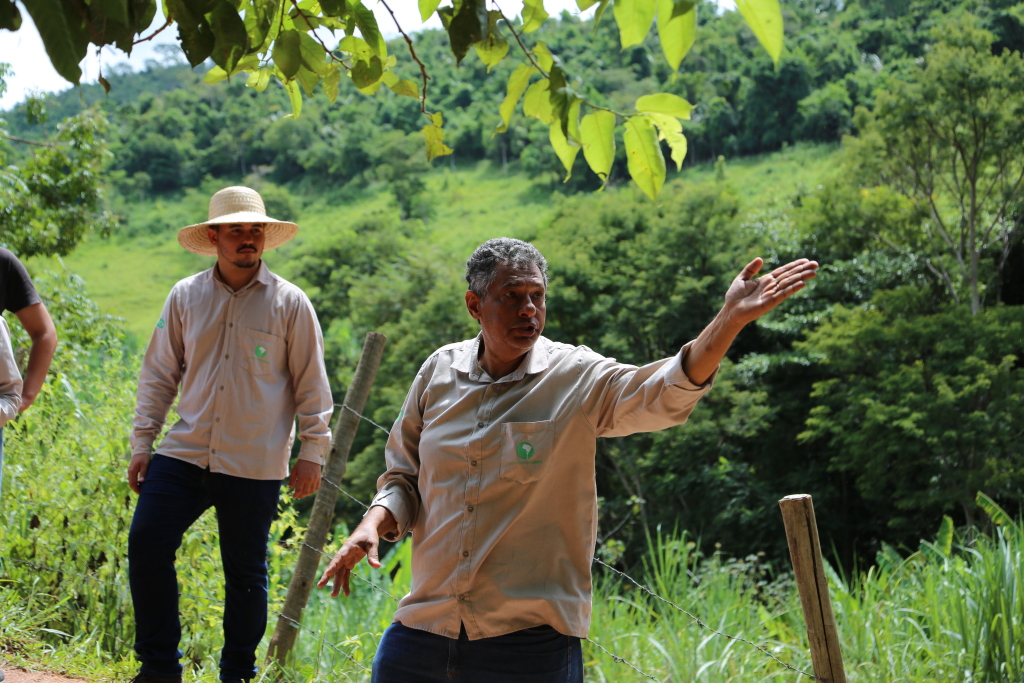
At the head of the KfW project, an initiative integrated into the Terra Doce program, Gilson lives the day-to-day work with those who plant the future. In an interview, he shares his learnings from the first year of the project, the challenges of restoring ecosystems under climate pressure and his commitment to the alliance between conservation and production to transform realities in the Doce River Valley.
Gilson, to begin with: when and how did the KfW project come about within Terra Doce?
The project began to take shape at the end of 2023, but 2024 was actually the first full year of implementation. Right from the start, we knew it would be a rich learning experience – and it was. Especially on the subject of mobilization. We changed our focus and adopted a more collective active search, with associations, local leaders and technical assistance institutions.
This change breathed new life into the program in its first year. And it was decisive in achieving the figures we achieved.
And what have been the main results achieved so far?
We had a goal of restoring 200 hectares, and we managed to implement 168 – including agroforestry and silvopastoral systems. And now, in 2025, we are already preparing the first 80 hectares of the new cycle.
More than the numbers, what matters is the model: we are integrating environmental restoration with sustainable production. That’s the great thing about Terra Doce. We are showing that it is possible to conserve and produce at the same time, with a real impact on those who live off the land.
What sustainable practices are being applied on the properties?
We have focused on biodiverse backyards, agroforestry systems and silvopastoral systems with rotational pasture management. The flagships are coffee and cocoa, but we also include bananas, fruit trees for pulp and other arrangements that bring economic returns and ecological balance.
In pastures, for example, we make contour lines, plant trees on the edges and divide the areas into small paddocks. The cattle move around in a controlled manner, the soil rests and the pasture regenerates.
How has the climate affected this dynamic?
It’s been a great challenge. The logic of rain has completely changed in the Rio Doce Valley. Before, we had a drought of three to four months. Now it’s seven, eight, even nine months dry. And when it rains, it’s a lot in a short space of time.
The annual average has fallen from 1,100mm to 700mm or 800mm, and this requires us to work more strategically: conserving water and soil has become a priority. Recovering water recharge areas, springs, riparian forests – all this is part of our approach.
And how are producers receiving this new model?
At first there was some resistance, which is natural. But now, we’re seeing great demand. The target for 2025 was 80 hectares, but if we accelerated, we could even reach 200. Even so, we want to grow carefully, steadily, to ensure that the model is solid.
Today, we have the support of leaders, town halls, secretariats, local associations… There is a collective perception that Terra Doce is here to stay. And more than that: that it can transform the Rio Doce Valley.
In conclusion, what is the project’s main objective for this second year?
Consolidate. We want to continue with environmental actions and, at the same time, implement sustainable production systems that serve as a model for the entire Doce River basin. It’s a step-by-step process – planting seedling by seedling, as our video-manifesto says – but with faith that each gesture is a seed of transformation.