


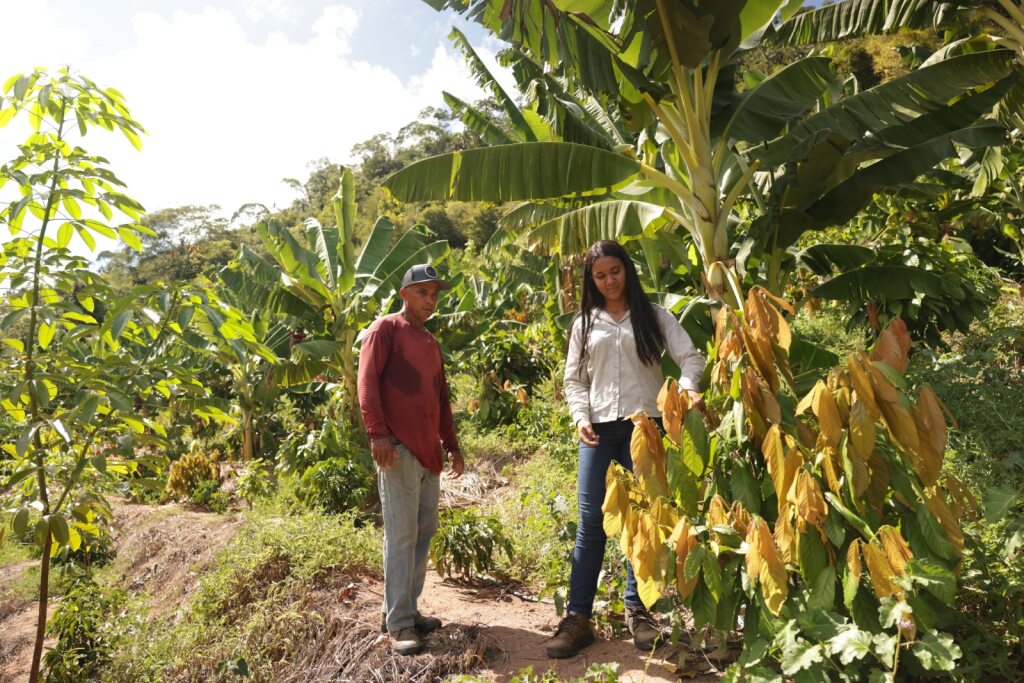
In the midst of the persistent devastation of the Doce River Basin – one of Brazil’s most emblematic regions in terms of environmental degradation and the historical neglect of sustainable public policies – the year 2024 marked a silent but profound turning point in the way ecological restoration and territorial justice are thought of and carried out. The Terra Doce program, coordinated by the Terra Institute with the support of the German bank KfW, took a leap forward not only technically, but also methodologically: it rethought its way of reaching those who matter most – rural families – and thus turned the key to scale.
For a long time, the majority approach to mobilizing families for ecological recovery actions followed the traditional path of “individual active search”. In other words, door-to-door action, in an almost artisanal logic of persuasion. In territories that are fragile, pulverized and distrustful by nature – marked by decades of unfulfilled promises – this strategy is effective but limited. The program, realizing that the scale required a new look, bet on what was internally called “collective active search”: instead of walking alone, they began to walk together with local institutions, such as associations, churches and schools – the spaces where community decisions actually take place.
The effect of this change was immediate and unmistakable. In 2024, the program exceeded its target for areas mobilized for conservation by more than 100%: 1,028 hectares were reached, compared to the 457 initially planned. The number of families also jumped, surpassing 320 family nuclei directly involved, with an impact on more than 600 springs mapped and included in the recovery actions. But the story goes beyond metrics. It lies in the trust that has been established between the Institute and the communities; in the word of mouth that circulates in the conversation circles of a settlement in Itueta or in the assemblies in Resplendor; in the word of mouth that legitimizes a program not just because of what it promises, but because of what it has already begun to give back to the land and to the people.
The territorialization of the strategy also underwent a refined technical cut-out. Based on studies that mapped the levels of degradation in the 28 municipalities covered by the program, regions with the greatest urgency for intervention were prioritized – an action that not only optimized resources, but also signaled the Institute’s commitment to decisions based on science and impact. Municipalities such as Conselheiro Pena, Alvarenga and Santa Rita do Itueto, among others, have become hubs for these actions, not only because of their necessity, but also because of their potential for replication.
The progress of structuring actions is also worth highlighting. More than 450 infrastructures aimed at soil and water conservation – including barraginhas, biodigesters and catchment systems – have been implemented, acting directly to contain erosion and increase water infiltration. Each of these structures represents more than a technical solution: they are, above all, tools of resistance against the desertification that is already threatening the region. And its installation was only possible through a fabric of partnerships that grows stronger year after year, including everything from town halls to farmers’ collectives, as well as local NGOs and universities.
The result is not just quantitative. It’s symbolic. In a territory where for decades the word “development” has sounded synonymous with exhaustion and expropriation, Terra Doce has been redesigning the collective imaginary of what “progress” can mean. This is not a noisy revolution, but a patient transformation, made with the time of the plants and the rhythm of the communities. It’s a program that walks in step with the rain that falls again, the tree that sprouts again, the young person who believes in the value of their land again.
At the end of 2024, what the program shows is that there is no restoration without bonds, trust and active listening. The real driving force behind Terra Doce is not just the numbers – impressive though they are – but the way it recognizes that the regeneration of the landscape begins with the regeneration of relationships. The Terra Institute, together with its partners and the hundreds of families mobilized, is showing that planting trees is not enough: we need to sow the future, put down roots of belonging and cultivate lasting alliances. And this, in a Brazil so marked by fragmentation, is perhaps the most radical action of all.