


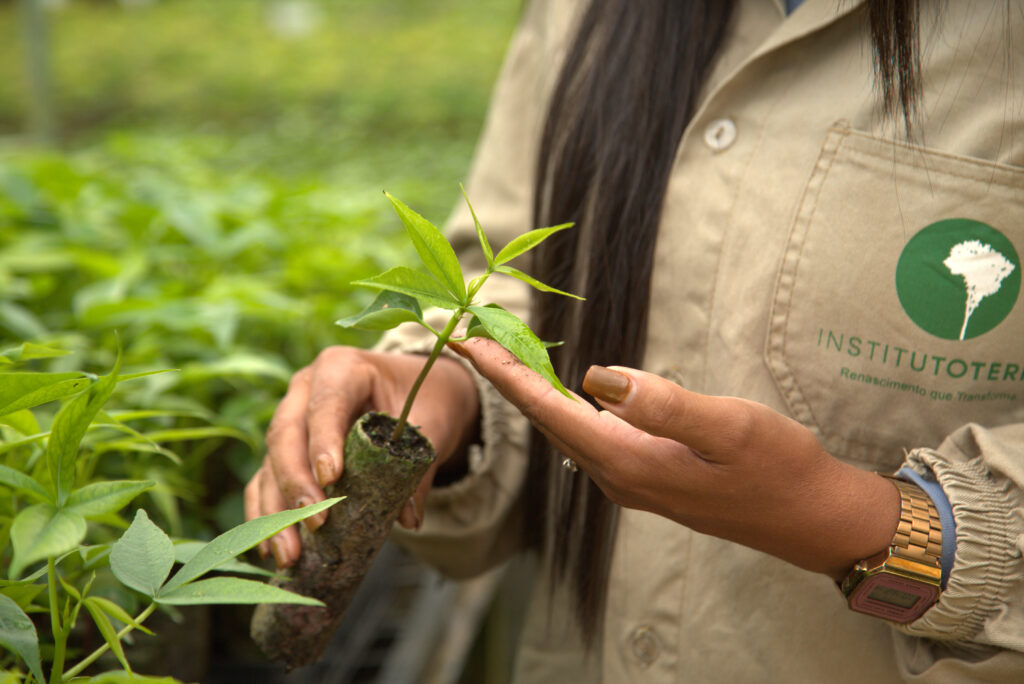
Research led by UENF, in collaboration with Instituto Terra, reveals a technology that increases the survival of native Atlantic Forest species
Ecosystem restoration is long-term work, and its first steps are decisive. In the nurseries and in the first days after planting, every leaf, every centimetre of growth, and every degree of temperature matters.
By closely examining this critical phase, an interdisciplinary team — composed of researchers Amanda Machado, Guilherme Rodrigues, Rosana Nani de Miranda, Diesily Neves, Larissa Barcellos, Silas Garonce, Moisés de Souza Marcelino, Newton Roda, Paulo Ricardo dos Santos, Cláudia Barros and Eliemar Campostrini — conducted an innovative study on how to protect native Atlantic Forest seedlings from stress caused by excessive solar radiation.
Led by the State University of Northern Rio de Janeiro (UENF), the research — published in the journal Trees (Springer Nature) in August 2025 — analysed the use of processed kaolin particle film (PKPF) as a low-cost, high-efficiency solution to improve the physiological performance of two species widely used in restoration: Cordia superba (babosa-branca) and Citharexylum myrianthum (tucaneiro).
The study sought to answer a key question in Atlantic Forest restoration: how can young seedlings, accustomed to nursery shade, survive and thrive when they begin facing direct sunlight in the open field.
The results were encouraging. The species treated with PKPF showed reduced leaf temperature, greater photosynthetic efficiency, better CO₂ assimilation and less damage to the internal structure of the leaves. This means that, with the use of the technology, seedlings experience less stress during acclimatisation and have a greater chance of successfully establishing themselves in degraded areas — a critical stage in Atlantic Forest restoration.
Instituto Terra’s contribution
Instituto Terra played an important role in the development of the study. The seedlings used in the research were produced in the organisation’s nursery, recognised for its technical quality and for the standardisation of production and acclimatisation protocols adopted in ecological restoration projects.
Instituto Terra’s Operational and Environmental Manager, Moisés de Souza Marcelino, contributed botanical samples from the nursery and supported the development of the experimental design — connecting field practice with scientific rigour applied to Atlantic Forest restoration.
In addition, Instituto Terra is cited as a methodological reference, highlighting its care with germination, shading, fertilisation, irrigation and hardening — practices that ensure vigorous and reliable seedlings for scientific investigations of this kind.
By supporting research such as this, Instituto Terra reinforces its role not only in environmental restoration but also in the production of technical knowledge that improves field practices, reduces losses, optimises costs and increases the efficiency of environmental recovery.
Why this research matters
With the advance of climate change and the increasing intensity of solar radiation, technologies such as PKPF may become important allies for improving seedling survival, accelerating the recovery of vegetation cover, and strengthening threatened ecosystems. Every plant that survives its first summer has a greater chance of becoming an adult tree — providing shade, water, food and life for its surroundings.
Overall, the research shows that the integration of science, practice and partners committed to conservation is essential for advancing the restoration of the Atlantic Forest and inspiring innovative solutions for other biomes.
Read the full article and learn more about the study.
Discover Instituto Terra’s work!
Explore our restoration and environmental education projects and see how it is possible to transform realities, one seedling at a time.